
01
Your position
The seat you can credibly own, and who is already holding the ones you can't.
Twelve months from now, you're the one they call. This is that year — your earned media, planned for you specifically, in the order that earns the next thing.
For people with a real record the market hasn't caught up to.

Most people at your level describe the same few moments.
Someone a decade behind you gets introduced as the expert on the thing you've been doing since before they started. A reporter quotes a peer on a question you've spent years answering better. A conference programs a panel you should have been on, and it didn't occur to anyone to ask.
None of that reflects your record. It reflects who knows about it.
And the advice never changes. Post more. Be more visible. Show up. You've tried some version of it, and it moved nothing, because volume was never the missing piece.
Earned media is the coverage you cannot buy. A reporter quoting you. A producer booking you. A trade title running your byline. A conference programming your talk. A judging panel handing you the award. Someone else, with their own audience and their own reputation at stake, decides you are worth featuring.
There are four kinds of visibility, and most people are running three of them.
Ads, sponsorships, boosted posts, the booth. You buy it, and it stops the moment you stop paying.
Your site, your newsletter, your podcast. Real, useful, and entirely your own word for it.
Social, reposts, the people who pass your work along. Reach without a gatekeeper.
Independent people, in their own words, on surfaces nobody in your company controls.
Three of the four are open to anyone with a budget and a calendar. That is exactly why nobody is moved by them. Earned is the one that has to be granted, which is what makes it the one that carries weight — and the only one that turns into the other three.
An interview becomes a clip. The clip becomes something you own. Once a piece has proven it moves people, it becomes the thing worth putting money behind. Earned, shared, owned, paid — one loop, running in one direction. It never runs the other way. You cannot post your way into being quoted.
A company is not citable. A person is. Reporters quote people. Producers book people. Panels program people. Awards are given to people. Every mechanism that builds credibility from the outside is pointed at a human being, not a logo.
So the founder goes first, and everything downstream gets easier. Your field gets something independent to hand a prospect. Recruits arrive half-convinced. Your claims have a source that isn't your own marketing. Your company stops being the only one saying it's good.
This is the faster of the two builds, and it is the one that carries the other. You become the name that gets recommended — by reporters to other reporters, by producers building a guest list, by the people deciding who gets asked.
Each of those started in the middle of a sequence that has a beginning.
Some rooms will say yes to you today. Some will only say yes once someone else already has. Knowing which is which is the whole year.
Every media category has a price of entry, and the prices are not the same. Some will take you on your record exactly as it stands. Others want to see that somebody already said yes. A few won't look at you at all until one specific thing is true, and nobody has ever told you what that thing is.
Skip the sequence and nothing compounds. You pitch for a yes you haven't earned yet, hear nothing back, and quietly conclude this doesn't work for people like you. That is how a year of real effort leaves no trace.
Your order is the first thing we build, and it belongs to you — your record, your category, your calendar, the doors already open and the ones that aren't yet. If there were a single order that worked for everyone, it would be on this page.
The seat you can credibly own, and who is already holding the ones you can't.
The people setting the terms in your space, and where you'd read as a variation rather than an alternative.
Every angle your record actually supports, scored and sorted by which door each one opens. Most people believe they have two. Most have a dozen and can't see them.
The ones you belong to, and the adjacent ones you already qualify for and have never thought to pitch.
Where your buyers read, and the titles where you'd be a novelty rather than a fit.
The publications open to someone at your level, and the argument only you could make in each.
What's realistic now, what you earn by month nine, and precisely what earns it.
The argument that would carry a serious stage, and an honest read on whether your record supports it yet.
The ones where your record actually competes, and the category you'd win rather than merely enter.
The windows in your year when your angle is already the story someone is looking for.
What earns what, month by month, for twelve months.
One for each media category, built on your angles and in your voice, so you never start from a blank page again.
And attached to every room, the gaps. You belong on that stage, and your framework has no name yet, and two of the three numbers you'd open with can't be substantiated. A map without what's missing is a horoscope.
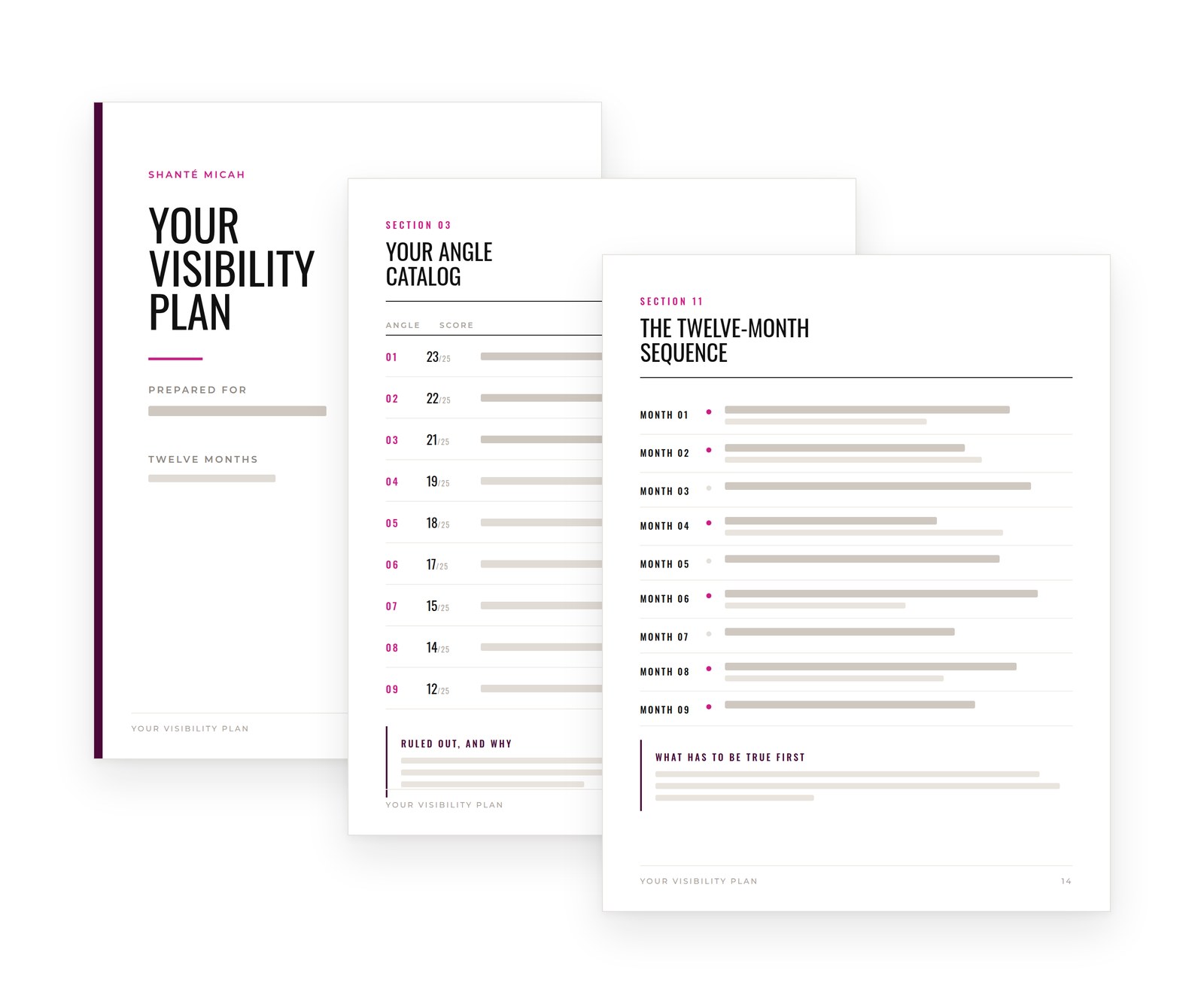
The work happens before we meet. The position scan, the angle catalog, the category work, the timing. All of it is done and in front of me when you sit down.
So it isn't a consultation. It's me deciding, out loud, with you, about your record. This angle and not that one. This category first. That publication in March, not now, and here's what has to be true by then.
Twenty years of judging which stories were worth a reporter's attention is the only part of this that can't be generated, and it's the entire thing you're buying.
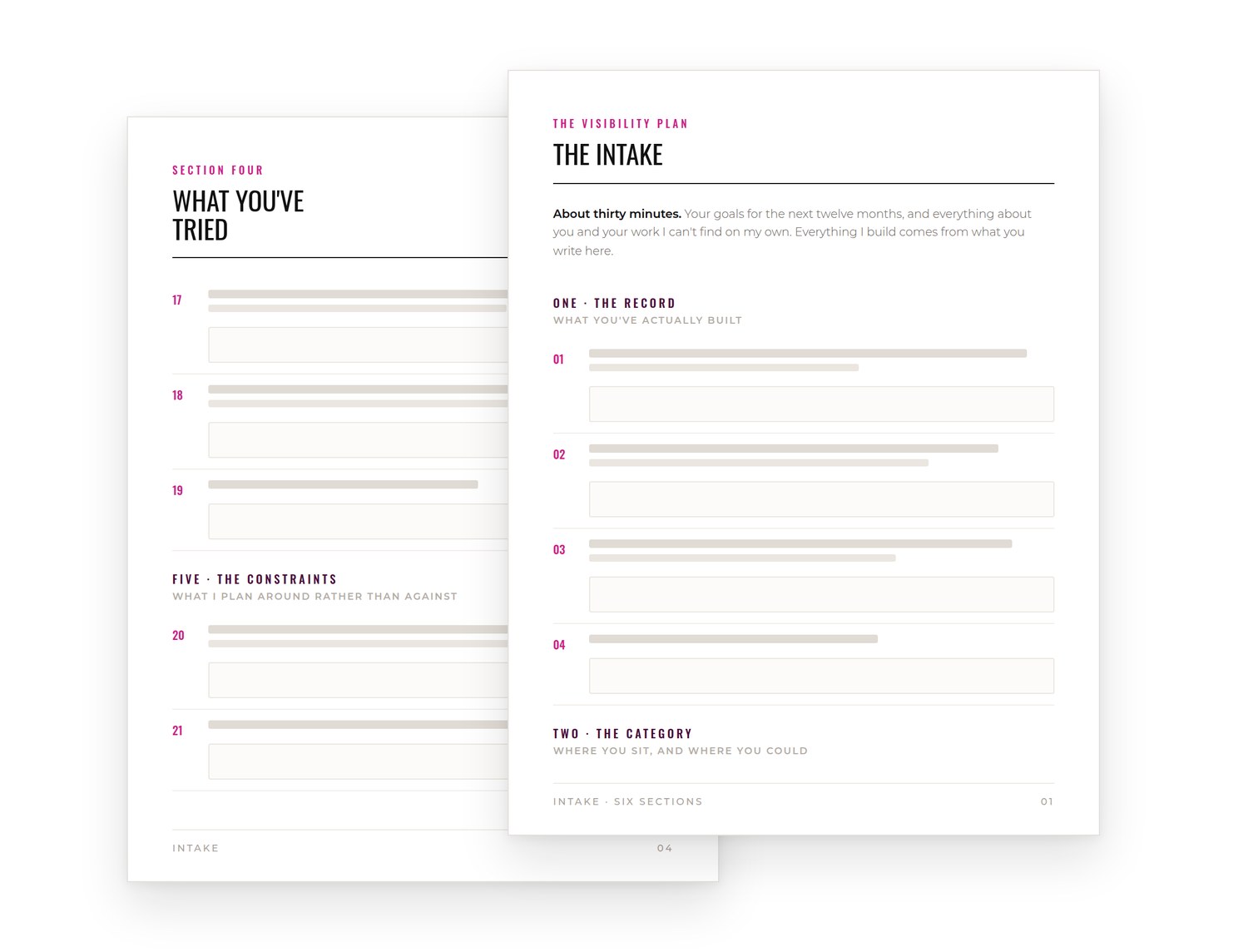
About fifteen minutes. It's a form, and it's the one that matters: your goals for the year, and everything about you and your work that I can't find on my own. That's what makes the plan yours instead of generic.
If something you wrote opens a door, I'll email and ask. Expect a short exchange before we schedule. This is usually where the best angle turns up.
Two to three hours of preparation you don't sit through.
Ninety minutes. We walk the whole plan, you push back where you should, and you leave with it — the plan, the recording, and your pitch formulas.

For twenty years I decided which stories were worth a reporter's attention.
The question I was asked most often by the people at the top of those companies was never how do I get coverage. It was: where do I actually belong, and in what order?
I answered it for them for two decades. This is that answer, for you.
Ninety-nine of a hundred pitches were deleted at the desk. Learning to write the hundredth is what twenty years actually buys.
Not famous. You don't want that, and it isn't what this builds.
None of that is promised. All of it is earnable, and none of it happens out of order. That's what you're buying: the order, and the judgment behind it.
A communications plan at this depth is a five-figure engagement from an agency. A comms hire who'd build it runs about $153,600 a year fully loaded, and arrives without the twenty years.
Limited availability at this price.
Code FOUNDERFIRST is applied for you at checkout. When the window closes this is private consulting at $2,500 — same session, same plan, standard price.
One session, one plan. Scheduled by email once your intake is back.
About fifteen minutes. It's a form, but a substantial one — your goals for the year plus everything about you and your work I can't find on my own. Everything I build comes from it, and a thin intake produces a generic plan, which is the one thing this can't be.
Coverage somebody else chooses to give you: a podcast interview, a quote in a trade title, a byline, a stage, an award. You can't buy it and you can't post your way into it, which is precisely why it carries weight the other three kinds don't.
No. The sequence tells you what earns the next thing, so running only the first quarter still runs it in the right order. A good share of the value is knowing what to skip.
No. All sales are final. The preparation happens before we meet and the ninety minutes are held for you, so the cost is spent whether or not you show up. You'll agree to the terms at checkout.
You get the intake and a booking link within one business day of purchase. Book any slot at least five days out from your completed intake — that gap is when the work happens, and it is the reason the session opens at depth. In practice most sessions land within the next week or two, depending on availability.
Q4 is the moment, and not incidentally. Year-end lists, 2027 prediction pieces and awards deadlines are open right now, and the bookings that fill January get made in November.
A plan built in September is a plan you can actually run.
Always on — so you don't have to be.